
 Posts


 A blog that I frequent often is Science and Religion: A View from an Evolutionary Creationist. The author, James Kidder, does an excellent job of providing updates on anything in the news related to evolution, intelligent design, and the ongoing debates. Recently, he has posted several short articles about Republican Vice-Presidential candidate Sarah Palin and her opinions about creationism, intelligent design, and the teaching of such subjects in schools.
I do not think that Intelligent Design is legitimate science, something that I will expound upon in the future; therefore, I do not think that we should be teaching Intelligent Design in our schools. Unfortunately, it seems that matters of both science and religion often are used and abused by politicians to develop a good public image and gain more support. One day a politician may support the teaching of Intelligent Design in public schools; the next day the same person may caution against such action. Perhaps they are being manipulative... or perhaps, like many people, they are not sure what they believe about evolution?
I will probably never vote for a "Christian" candidate because I think that my political ideology should direct my support of candidates and policies. My religious perspective certainly directs my political ideology to a degree, but my religious preference should not direct my support of candidates and policies. I will certainly not support a candidate simply because he shares my religious preference.
I think this same reasoning can be applied to the natural sciences. I do not want a "Christian" science because I think that science should be directed by methodological naturalism. I suppose you could argue for a different scientific ideology, but science has always been directed by methodological naturalism... that is the whole point of science, to find naturalistic explanations for observable phenomenon. To explain observable phenomenon with a non-naturalistic explanation such as the presence of an intelligent designer is simply non-scientific... according to my scientific ideology. Intelligent Design is developed from a scientific ideology that is directed by a religious perspective, usually Christianity. Seriously, if the creation stories of Genesis were not in the Bible, would the theory of Intelligent Design even exist?
Monday, September 8, 2008
Politics and Perspectives


Thursday, August 14, 2008
"We're just plain gullible."
Not a lot of time to post this week... I just started a full-time job and my marriage is two months old, so I'm busy. But I thought I'd link to this article and leave a quick comment. I have a big-time post series coming up sometime soon, the kind of ideas that (for me) are faith-changing. Many of you (the three people reading this) have probably heard of Todd Bentley and the enormous "revival" happening in Lakeland. Bentley has stepped down and his marriage is possibly ending. The change in opinion from the author of the above article is amazing. This pentecostal was convinced Todd Bentley was healing hundreds and then thinking it's all fake because of marriage problems.
What were you thinking before, J. Lee Grady? Everyone has personal problems; a broken marriage doesn't make Bentley's ministry a fake. There are plenty of other reasons.
Now, let me make this clear: Bentley's or anyone else's worship down there in Florida is no less legit than mine. Our worship pleases God by his grace, not by our attitude or orderliness or emotions or level of perfection of theology.
On the other hand, the reason Christians were buying into the healings was admitted freely and insightfully stated by J. Lee Grady: "We're just plain gullible."
I suppose it's just human nature to trust something that matches your ideology without thinking critically about it. But I have to admit I am amazed again and again the extent this is true for charismatic-minded believers. Some thoughts:
- The format of these "healings" were just silly. People would come up on stage, either claim to be healed or ask to be healed for this or that, Bentley would interrupt them mid-sentence and push them over, they'd be dragged off stage and you'd never see them again. Not exactly in view for all to examine.
- The "revival" really didn't demonstrate many people at all moving from "skeptical" about movements of the Spirit to "believers." Indeed most everyone who went down there was charismatic before they heard about it. The reason it was larger than the past was new MARKETING: internet marketing and broadcasts, specifically.
- The day that someone performs 1000s of legit healings in a couple months time, there will not be tens of thousands or hundreds of thousands showing up. There will be MILLIONS. Millions and millions and millions. All the healings will not fade away into unverifiability within a week. They will be touring the talk show circuit, all over the newspapers, etc. The "secular media" will not be able to keep it under wraps but will have to embrace it. If this really happens, everyone will hear.

- Just because something appears, on the surface, to be a "healing" doesn't mean crap. Lots of things are hard to explain or appear miraculous that aren't. Think magic tricks.

I certainly believe God is capable and willing to do incredible, unexplainable things here and now. But I think, as Christians, it is imperative that we think critically and skeptically to separate what God's doing from what we're making up.
As for those eager for a new movement of the Spirit to overcome our world, I recommend reading this post.
Tuesday, August 12, 2008
Who is responsible?
 At the end of Some “Evil” Thoughts, Joe posted a YouTube parody of the “Mythbusters” television show. In this video, two guys try to disprove God’s existence by testing the effectiveness of prayer. The video is a funny parody, but what caught my attention were these lines:
2) not caused by God But if we look to the scriptures, we find a different perspective about God’s interaction with his creation. The Bible reveals to us that God is ultimately responsible for everything, from the rise and fall of civilizations to the provision of food for the birds.
Saturday, August 9, 2008
Some "Evil" Thoughts
I just got done commenting on a post at one of our favorite blogs, Beyond the Firmament. The post is titled The Problem of Evil. This is a tough topic for Christians and outsiders to Christianity to wrestle with. I definitely recommend reading Gordon's post. Here's some further thoughts on the subject from myself: Philosophical debate about "the problem of evil" often proceeds with the deck stacked beforehand. We accept the assumption that there is nothing worse than physical pain, no possible result of an event worse than death.
But most cultures throughout history (including the cultures that gave us the Bible), have believed there are plenty of things worse than pain or death.
Our misunderstanding is commonly reflected in our Western understanding of the cross. How many Good Friday services have you been to that described in gruesome detail just how painful the crucifixion was, telling us how he had to push himself up with his feet to breathe, how much flesh was torn because of the cat of nine-tails, etc? Or how about Mel Gibson's passion movie? Talk about graphic violence.
Certainly Christ's death was extraordinarily painful. But I challenge you to find one statement in the New Testament that points out or emphasizes how excruciatingly painful his death was. You won't find one.
On the other hand, you will find statements all over the place about how Jesus was humbled/humiliated in his death. This is because Jesus' choice of humility over honor is much more significant to the Bible's original readers than his choice of pain over comfort. To them there are plenty of things worse than physical pain.
Furthermore, I have been reading straight through the Bible and am in the middle of Kings. And I have not found one tiny hint of concern for the afterlife or trembling fear of death that we in Western culture are obsessed with. We think of death as the worst possible result of life, but to the ancient Israelites, there were plenty of things more important than life's end, such as concern for your descendants. I think they were smarter than us, because eventually death comes for us all, no matter if it is soon or far off!
This leads to some problems for people who rely heavily on the certainty that there can't be a God because of evil in the world. Here's a typical YouTube from an atheist who shows pictures of starving children in Africa and challenges us to tell those kids there's a God.
Apparently these kids would have been better off never being born???? Chances are the kids already believe in God, so I don't have to tell them there is one. But I challenge an atheist like this one to go relate to those starving kids what is said in his/her video: If there was a just God, he would not have created you, because your life would be better off never happening. I'll go out on a limb and say the kids disagree.
Obviously, people suffering as a result of the unfair dealings of men is a tragedy that the church should be ashamed of not doing enough about, as that atheist rightly points out. But to argue that the presence of pain and death proves there is no God is to make two mistakes:
1. It devalues the lives of these starving children, because it diminishes the value of the very gift of life, telling starving kids that if there were any justice in the world they wouldn't have been born.
2. It wrongly imposes our attitude about what ultimately matters most on the majority of cultures in the world who didn't think like us at all. It's a philosophical arrogance to say that we know what's really bad and good compared to non-Western peoples.
Of course, this doesn't solve the problem of evil. That discussion is still a good conversation to have. But hopefully this post illustrates some problems with the debate as it's usually carried out.
The moral of the story? Leave the God-proving to the experts:
Thursday, August 7, 2008
Book Review: The Language of God
 In his book “The Language Of God,” Francis Collins addresses the question: “In this modern era... is there still the possibility of a richly satisfying harmony between the scientific and spiritual worldviews?” If you are unfamiliar with Francis Collins, then allow me to enlighten you. Francis Collins was the director of the Human Genome Project, a thirteen year long project that involved thousands of scientists and lab technicians. This great endeavor culminated in the mapping of the entire genetic sequence of humans. Francis Collins mentions his involvement with the Human Genome Project throughout the book, but the project is not the focus of his writing. Instead, Collins hopes to enlighten his readers about the theory of evolution, its place in our understanding of life, and how it relates to our faith in God.
“The Language Of God” is divided into three main sections. The first section takes on an autobiographical feel as Collins describes his upbringing and early perspectives on religion. The second section focuses on the origins of the universe and life. Also included is a scientific explanation about DNA and genetics that is very accessible to the general reader. In the third section, Collins proceeds to outline the different perspectives about evolution and creation. The book ends with encouragements for Christians and atheists to recognize both the capabilities and limitations of science, as well as the place of faith in our lives.
I picked up this book expecting a detailed explanation of how genetic evidence indicates that the theory of evolution is a valid explanation of the diversity of life that exists today. Collins certainly delivers in that respect, and in ways that are very accessible to someone without a doctorate in genetics. However, there is more than scientific jargon bound between these pages. Reflections on his own faith journey are a valuable insight into how the reader can begin to incorporate these concepts about genetics, evolution, and the origins of the universe into his own understanding of scientific theory and spiritual belief. Collins reveals the shortcomings of both atheism and Intelligent Design and eloquently provides the reader with a third option that compromises neither the theory of evolution nor a belief in God.
I recommend this book to anyone who is interested in the evolution/creation debate, regardless of your current position or religious attitude. Collins speaks to both the ardent atheist and the devout believer. There are words on these pages for both the mind and the heart, a pair too often in conflict, which Collins challenges the reader to reconcile in harmony.
Wednesday, August 6, 2008
Inerrancy: Does God tell the truth?
 In my last post, I mentioned that I completely trust the scriptures in matters of doctrine (a collection of beliefs) and ethics. But what about questions of history, chronology, and science? This is the matter of inerrancy: the idea that the scriptures are completely free of any error in regards to all matters of history, chronology, and science.
Monday, August 4, 2008
Trading in fortune cookies for Biblical understanding (3/3)
(This is part 3 of 3 of a series on Biblical exegesis. If you haven't yet, please read parts 1 and 2 before reading part 3.)
If we take the Bible seriously by reading large portions at a time, trying to understand the gist of entire books, connecting each sentence to the one before it, etc., we may not agree on exactly what it’s saying, but we will have a more truly Biblical basis less corrupted by our own philosophy and agenda. God’s Spirit will work through this understanding to further add to our understanding of Jesus Christ as God.
Here are some practical steps we can take: Get some decent background materials to fill you in on the world the Biblical authors were writing in. One I’m reading right now is Introducing the Old Testament by John Drane. I’m loving this book. It is written from a scholarly perspective but is not hostile to Christianity. It is honest about when books were likely written, the accuracy of the early stories of Israel’s history, etc.
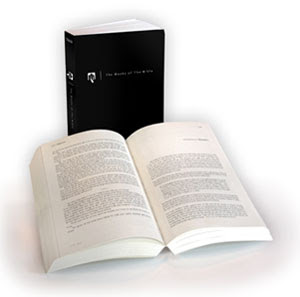 Ultimately, I recommend purchasing a copy of the International Bible Society’s “Books of the Bible” and making it your regular reading Bible. Besides having great book introductions and a more sensible book order, it gets rid of all the numbers and inserts more thoughtful passage breaks, making it natural and easy to read the Bible with the intention of figuring what you’re reading is actually about.
Most people I present this idea to contend that the reference advantage of chapters and verses are too advantageous to shirk, but “Books of the Bible” still keeps the numbers in the corner so that you can find the general area. What it does do is force you to see the context in which the passage being referenced is in. What a shame!
Since I have started using “Books of the Bible” I started a full read-through of the book and am currently in the middle of Kings. My understanding of Genesis-Samuel has increased ten-fold by reading this Bible.
No matter what the solution, though, it is time to trade in our fortune cookies for a true understanding of the Bible, if we want the good book to direct our faith in Jesus.
A final note: Will I be citing scripture on this site?
I make it my goal at this point to never cite scripture in the format “Book #:##,” even if I’m talking to someone in person. Instead, I’d rather say, “In the middle of Book X, when Character X is doing Y, the prophet Z says to him, ‘blah blah blah blah.’” Not only will this force me to recognize the context of the scripture I am sharing, but it will force the person I’m talking to to think about where the verse is coming from as well.
I intend to employ the same strategy on this blog.