
 Posts


Imagine a beautiful 15-foot by 20-foot painting of a mountain. It’s grand. It’s beautiful. It’s full of fun details to understand or just marvel at. This is the Bible of early Christianity.
Now imagine someone takes that painting and turns it into a 30,000 piece jigsaw puzzle. This is our modern Bible. Hundreds of years ago, Stephen Langton and Robert Estienne sliced our scriptures into distinct portions of regular size. Our chapter numbers, verse numbers, and subheadings break the Old and New Testament up into bite-sized portions that fit together nicely but are found more often on their own.
Most Christians could tell you all about the individual pieces, and have even memorized a few. Some Christians could tell you about the piece with part of a climber’s hand on it, or the one with the head of a mountain goat on it. They’ve seen some pieces with snow on them (they thought those pieces were just blank), and some with grass. They’ve even seen the piece with the mountain top on it, although it didn’t look much like a peak all by itself.
Christians have favorite jigsaw pieces that they motivate their lives with. They name their organizations and fellowship groups after the most well-known puzzle pieces. They are even so dedicated as to study a whole section of puzzle once piece at a time, squeezing meaning and reflection out of each piece, not skipping a single one.
And yet, ask those same Christians about the huge tree near the base of the mountain, and chances are they’ll have never seen it or even heard of it. Or the team of hikers? They’ve heard of that, and have even been pointed to a piece or two with a part of a shoe or a hat on it, but have never seen the whole hiking team together. In fact, most Christians, although they could tell you that the whole painting is certainly, definitely a painting of a mountain, have never actually seen the mountain for themselves. Or ask a Christian what this or that section of the painting is of, and they’ll have no idea, except to say, “That’s the bottom half of the mountain,” or “That’s the top half.”
This is a strikingly accurate analogy of our modern Bible reading experience. Our Bible, hundreds or thousands of years after its writing, was split unnecessarily into 1,200 chapters and 31,000 verses. Beyond that, new editions constantly add their own subheadings. We have verses memorized, we dedicate ourselves to verse by verse studies, we craft mission statements based on verses, we depend on them for encouragement, and we recognize verses just by their “John 3:16”-style references.
And yet, very seldom do we take a couple of the puzzle pieces, put them together and realize that what we thought was a mountain peak actually turned out to be a tent at base camp. We rarely realize how connected to each other Bible verses are. We do vaguely know of the overall story, but to describe what one book is about as a whole, or Paul’s main points to the Philippians, or the thematic differences between Matthew’s Gospel and John’s Gospel is a task we’ve never even considered.
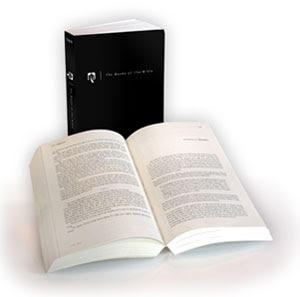
Why do we persist in reading the Bible this way, myopically focusing on one piece at a time and missing out on the beautiful larger strokes God has given us through his scriptures? I suggest that Christians must stop reading Bibles with subheadings and verse and chapter numbers, and instead read a presentation of the Bible without such arbitrary divisions. I personally only know of one such Bible currently in print, and I strongly recommend it: The Books of The Bible, a presentation of the TNIV published by the International Bible Society. Reading the Bible without distinguishing between the individual pieces has energized and put a fresh perspective on my Bible reading over the past year. It’s like reading a whole new book and seeing the whole big picture—and smaller sections of the picture as well—like I’ve never seen it before.
But is this extreme measure necessary? Reading a whole new Bible without ANY numbers? After all, most of us own several chapter-and-verse-equipped Bibles that are fully intact and contain every word. The whole picture is there, right? I would argue that this isn’t good enough, for two reasons.
First, looking at the original image of the mountain is clearer and more satisfying than looking at the puzzle version with dividing lines all though it, even when it’s all put together. In the same way, even if you read three chapters at a time, your effort to understand the passage as a whole is constantly interrupted by tiny numbers every dozen words or so. Why put hurdles in your way every 15 yards when you’re trying to run a marathon?
Secondly, although we may have Bibles that contain all 31,000 puzzle pieces put together in the correct order, we’re so used to being fed one puzzle piece at a time in church, on the radio, in conversation, on merchandise and in books that unless we eliminate the verse numbers altogether, they naturally control the framework in which three think about the Bible. For example, you likely didn’t even notice that I said “read three chapters at a time” in the paragraph above because three chapters at a time is a perfectly normal way to read.
And yet, why end at three chapters? Just because of arbitrary divisions installed in the thirteenth century? What’s that have to do with anything? Since the chapter markers were added hundreds of years after the books were written and often end right in the middle of an important passage, it would make more sense to stop reading when there is a natural break in narrative. But because of our tendency to think of our Bible reading in terms of chapters, this concept barely computes.
A common reason one might contest this and argue for a Bible with chapters and verses is for the sake of referencing particular sentences. The Bible, with all 66+ books together, is incredibly long. If you need to tell someone about Jesus feeding 5,000 people, it’s easier to simply say, “Luke 9:10-17” than it is to say, “In the first half of Luke, when Jesus is still doing his ministry in the Galilee area, in the middle of the passages that focus on Jesus’ disciples and their understanding of his identity, we find…” That’s reason enough right there to keep the verses in, right?
Actually it’s just the opposite. Think of the puzzle analogy again. What makes more sense: to say, “At the intersection of the 55th piece from the top and the 209th piece across, there’s a man with no gloves on,” or, “Down near base camp, in the cluster of tents, next to the campfire, there’s a man with no gloves on”? The first way may be more exact and quck, but which way promotes better understanding of the photo as a whole? Which one is more helpful to the reader in the long run? Which way assures that the man with no gloves on will not be taken as a crazy person?
In the same way, referencing parts of the Bible without chapters and verses promotes a full understanding of a section in the context of the book and of the story of the whole Bible. It also discourages taking the Bible out of context. Besides all this, I would guess that most Bibles published without verse/chapter numbers are like The Books of the Bible in that they feature chapter references someplace convenient but out of the way, such as the corners of the pages.
It’s amazing what the Holy Spirit does through our crude treatment of the scriptures, bringing meaning to us from just a couple of pixels. However, why work against His effort to help us understand His Word by focusing in so narrowly? I suggest we each get a copy of Books of the Bible or a similar Bible presentation, and allow the Holy Spirit to help us see the beautiful paintings his human authors create in full.
Thursday, January 22, 2009
The Bible as a Jigsaw Puzzle


Monday, August 4, 2008
Trading in fortune cookies for Biblical understanding (3/3)
(This is part 3 of 3 of a series on Biblical exegesis. If you haven't yet, please read parts 1 and 2 before reading part 3.)
If we take the Bible seriously by reading large portions at a time, trying to understand the gist of entire books, connecting each sentence to the one before it, etc., we may not agree on exactly what it’s saying, but we will have a more truly Biblical basis less corrupted by our own philosophy and agenda. God’s Spirit will work through this understanding to further add to our understanding of Jesus Christ as God.
Here are some practical steps we can take: Get some decent background materials to fill you in on the world the Biblical authors were writing in. One I’m reading right now is Introducing the Old Testament by John Drane. I’m loving this book. It is written from a scholarly perspective but is not hostile to Christianity. It is honest about when books were likely written, the accuracy of the early stories of Israel’s history, etc.
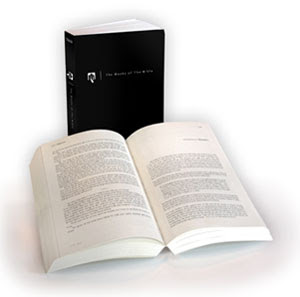 Ultimately, I recommend purchasing a copy of the International Bible Society’s “Books of the Bible” and making it your regular reading Bible. Besides having great book introductions and a more sensible book order, it gets rid of all the numbers and inserts more thoughtful passage breaks, making it natural and easy to read the Bible with the intention of figuring what you’re reading is actually about.
Most people I present this idea to contend that the reference advantage of chapters and verses are too advantageous to shirk, but “Books of the Bible” still keeps the numbers in the corner so that you can find the general area. What it does do is force you to see the context in which the passage being referenced is in. What a shame!
Since I have started using “Books of the Bible” I started a full read-through of the book and am currently in the middle of Kings. My understanding of Genesis-Samuel has increased ten-fold by reading this Bible.
No matter what the solution, though, it is time to trade in our fortune cookies for a true understanding of the Bible, if we want the good book to direct our faith in Jesus.
A final note: Will I be citing scripture on this site?
I make it my goal at this point to never cite scripture in the format “Book #:##,” even if I’m talking to someone in person. Instead, I’d rather say, “In the middle of Book X, when Character X is doing Y, the prophet Z says to him, ‘blah blah blah blah.’” Not only will this force me to recognize the context of the scripture I am sharing, but it will force the person I’m talking to to think about where the verse is coming from as well.
I intend to employ the same strategy on this blog.
Friday, August 1, 2008
Trading in fortune cookies for Biblical understanding (2/3)
 (This is part 2 of a 3 part series on reading the Bible. Please read part 1 if you haven't yet.
In the last post, I talked about why reading the Bible in short bursts (a verse, a paragraph, or a chapter at a time) doesn’t make a lot of sense, as the Bible is 66 books and not 31,000 Bible verses. I said that we’re not getting a clear picture of what the Bible is about this way.
But if we’re not learning what’s truly in the Bible, what are we learning?
Without strong training and concentration, our understanding from a typical Bible comes not from the Bible itself, but from our own experiences, our own theology, or some random thought that pops into our heads.
I have heard a lot of people refer to this as “leaving room for the Spirit” to teach. But that’s silly. In helping understand the Bible, the Spirit should be working in cooperation with the books, not apart from or against them.
I’m not speaking purely on minor points. I would argue that 80% or more of what a Bible reader learns actually comes from what he already knows about theology and his/her own ideas/experiences that he/she remembers as he/she reads the Bible, not from what the Bible is actually teaching.
So what am I saying, that the whole of Christian understand and teaching is totally wrong?
The odd thing about all this is that of course God’s Spirit still works mightily as we read the Bible in any form. A few posts ago I referenced Woodrow Kroll’s “Back to the Bible” radio program, saying it sometimes has very little to do with getting back to the Bible. I said that because Mr. Kroll will sometimes talk about one verse of the Bible for an entire teaching. What does that have to do with understanding the Bible?
Some might portray this as a high respect for the Bible, positing that every verse has a wealth of wisdom for it. The truth is this: That’s absolute nonsense. If you want to show a high respect for the Bible, read everything the author had to say instead of one sentence. Reading one or two sentences like Kroll sometimes does on “Back to the Bible” does not teach us the Bible authors’ agendas. Instead what we get from “Back to the Bible” is teaching on Mr. Kroll’s theology, life experience, and wisdom. And here’s the tricky part: I still appreciate Kroll as a man of strong, ethical and wise faith in God, and he has a lot of meaningful things to say that God’s Spirit works through him to provide. So why complain, right?
I have to complain because of the potential misuse this kind of “Bible teaching” leaves us open to. Sure, Woodrow Kroll is a nice guy, but what about the people who argue that the Bible says ”God hates fags”? Or what about the people who argue the Bible says that the heavy beat of Christian and secular rock music make it inherently evil? What can someone like Kroll say to them?
He’d probably say they’re taking the Bible out of context. This is the catch-all phrase to denounce someone else’s “Biblical” belief. But we need to stop using this phrase until we ourselves start taking the Bible more seriously as a piece of literature. The sad, sad truth is that most Bible readers are taking the Bible out of context in the same exact manner as those they denounce. The reason it seems better when we do it is because our message our is positive and loving, or because our message fits in with a more mainstream doctrine. And although that doctrine may have come from the Bible originally, as we study the Bible, we usually rely on the doctrine instead of its source.
Skeptics are starting to catch on and are unfortunately reading the Bible with cynical, misguided views about whether or not the Bible’s God is truly loving, rational and forgiving, which he is. If we do not start reading the Bible in true context these problems will only escalate!
In the next post, I will give some suggestions about how we can better read and teach the Bible.
Thursday, July 31, 2008
Trading in fortune cookies for Biblical understanding (1/3)
This blog has been dominated so far by discussion on the nature of the Bible. We haven’t covered science, politics, the end times, movements of the Spirit, or any other such topics. I’m not surprised since our understanding of the Bible builds a foundation for our opinions on the other subjects.
And although my first few posts may have raised your suspicion as to my dependence on scripture, let me make something clear: Although I believe treating the Bible as the center of Christianity is misguided, I also think the importance of the Bible for Christians cannot be overstated.
It is not the center of our faith, but it is the infallible, authoritative source and God’s word on his nature, the nature of our lives, and our relationship to him.
Therefore it is of highest importance to me to take the Bible seriously, to find out what’s really in it and to corrupt its message as little as possible with my own agenda.
What’s the problem?
I have come to believe that our most common Bible-reading techniques to not meet any of the three above objectives. The main problem is how much we read each day. Reading a verse, a paragraph, or a chapter at a time is a really bad idea.
Reading, studying, discussing, and preaching on the Bible in short bursts doesn’t take the Bible seriously in that it ignores the Bible’s self-established format of books. When you read any other book, do you commonly cite one sentence to make an important point? How about reading it one paragraph or one page at a time?
Worsening the situation further is that our current Biblical divisions (chapters and verses) are totally arbitrary and don’t have much to do with the original authors’ words. Would you read a book that someone else had gone through first, inserting lines and divisions all over the place that had little to do with the actual book content? The Bible is a collection of 66 books, not 31,000 fortune cookies.
The combination of reading such short segments and breaking them up with little numbers all over the page is that it is very hard to tell what the books of the Bible are truly about. Knowing, though, that we are supposed to glean truth from the Bible nonetheless, we concentrate harder or pray or expect revelations from God’s Spirit to just reveal what the heck we’re reading.
The Bible isn’t supposed to be boring or difficult to understand. Just the opposite, it’s the most exciting and transcending book ever written! With a little historical/cultural background info, a notebook to take notes in, and someone with which to discuss what you’re reading, I can’t imagine or more exciting, enjoyable, motivating, or spiritual process.
In the next post, I'll expose more of how the way we tend to read the Bible is so... unbiblical.