
 Posts


 In my last post, I mentioned that I completely trust the scriptures in matters of doctrine (a collection of beliefs) and ethics. But what about questions of history, chronology, and science? This is the matter of inerrancy: the idea that the scriptures are completely free of any error in regards to all matters of history, chronology, and science.
Wednesday, August 6, 2008
Inerrancy: Does God tell the truth?


Sunday, July 27, 2008
Infallibility: Can we trust the Bible?
 In my last post, I offered thoughts about what Christians mean when they refer to the Bible as the “Word of God.” While discussing the role of human authorship in the scriptures, we must confront this question: Can we trust a book written by sinful people.
Because God was actively involved in the creation of the scriptures, I believe that we can completely trust the scriptures when they speak on certain matters. These matters would be doctrine and ethics. Doctrine is a collection of beliefs (usually in the form of statements) about God and humanity. We develop doctrinal statements through the process of theology, which is the study of God. Ethics are beliefs about what is right and wrong, and by extension Biblical ethics are beliefs about what is right and wrong according to the Bible.
Christian theology must rely primarily on the scriptures to develop our doctrine; they are the most reliable resource available for understanding God. No mere man could fathom the reality of God. So through the centuries, God gave insight and wisdom to the authors of scripture so they could write truthfully about the character, attributes, and values of God. When Jesus Christ walked the earth, those qualities became manifest in the man who was “the image of the invisible God.”
The Bible should be important to Christians because it is our most valuable resource for understanding the person of Jesus Christ and our relationship with him. In his series “What is at the center of Christianity,” Joe writes that Jesus Christ is the center of our religion, and the Bible points us towards him. The greater purpose of every book of the Bible is to draw the reader closer to Jesus Christ.
My simple thought on Biblical ethics goes like this: a Christian’s beliefs about right and wrong should be based on God’s beliefs about right and wrong, which we learn through studying the character, attributes, and values of God found in the scriptures, and direct statements about right and wrong found in the scriptures reveal aspects of God’s character and values. The Bible is not a set of rules or instructions, but it does help us understand the character and values of the God we are called to emulate. It is written in Leviticus, “Be holy, because I, the Lord your God, am holy."
So as we come to the Bible with a desire to understand and know Jesus Christ better, I believe that the scriptures will not fail to guild us into a greater understanding and deeper relationship with Jesus Christ. This is the explicit purpose of the scriptures, and it is the matter on which they are infallible. But what about questions of history, chronology, and science? In my next post, I will discuss the issue of inerrancy.
Saturday, July 26, 2008
Codex Sinaitacus Uploadicus
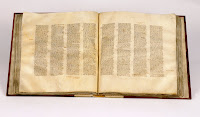
The oldest full copy of the New Testament, the Codex Sinaiticus, is going digital..
That's pretty neat. It means anyone can look at it for themselves. Of course, they can't read it unless they know Koine Greek, but it's neat, nevertheless.
The CS has been studied for a couple hundred years and has been an important text for figuring out what the original authors of the Bible meant. It, of course, has been important in the authoring of modern English translations, such as the NIV, TNIV, ESV, RSV, NASV, etc. So it's neat that it's online, but it's not world-shattering.
Looking up stories on Google News, I was surprised and pleased for the most part with the way the press has handled it. They did not run with the popular "The true Bible is so different from the one in your house" story. (It is clear most of the stories on the Codex Sinaiticus are written from a press release.)
There were exceptions, though:
- TechRadar reports that the CS is different from today's Bible's in that it doesn't include the resurrection. But the CS affirms the resurrection in all four Gospels. What it doesn't include are the last 12 verses in Mark (which contains all of Jesus' resurrection appearences from Mark, not his resurrection). These twelve verses are noted as probably unoriginal in most modern translations of the Bible.
- Slashdot made the same mistake. Whoops!! (I'm not sure how this site works. Was this on the front page, selected by the editors? Perhaps not.)
- The AP contends that the CS has "a few interesting differences" from my Bible, such as missing the resurrection appearences of Mark. But my Bible, which is TNIV, makes it very clear that those verses likely don't belong.
- This website highlights the many differences between modern Christian belief and this ancient manuscript. (Actually that site is a nice jab on the unbiblical thinking of most Christians. I found it to be quite humorous.)
I have to admit, I do hear Christians quote the end of Mark more often than I'd like. But its absence from the CS is neither troubling nor surprising. (Nor is it indicative of the level of difference between the rest of the CS and a modern Bible.)
Overall I am pleased with the media's reporting of the event. The only thing that makes me sad is how many Christians are surprised to discover the end of Mark doesn't belong there!
Thursday, July 24, 2008
Inspiration: Who wrote the Bible?
 In Part 2 of “What’s at the center of Christianity,” Joe mentioned that the Bible is often referred to as the “Word of God.” What does this mean?
Many Christians believe that God inspired the Bible. This type of inspiration is different from that of an artist who responds emotionally to some external factor (nature, people, etc.) by creating a work of art. The authors of the Bible were not merely responding to an experience with God, but God himself was active in the creation of the text.
But how was God involved? Are the words of the Bible a heavenly dictation or human musings? Neither option is very appealing. Either God directly manipulated the authors, or the text was written by humans… who are prone to mistakes and misunderstandings.
We do have Biblical text that was dictation from God. We call it prophecy, and you need only turn to Isaiah to find a very obvious phrase like, “The Lord has spoken this word.” The mark of a good prophet was speaking only the very words of God… often to people that did not want to hear the truth. In the Old Testament we have a collection of prophetic oracles, words directly from God, which were written down. But what about the Psalms, the narratives, and all those letters?
Perhaps God and the authors worked in some type of partnership. Each author brought his own personality, style, and cultural background into the writing. God brought insight and wisdom so that the authors could understand and explain things that only the mind of God could comprehend. Most books in the Bible were written to address particular situations, and through insight and wisdom from God, each author was able to respond to those situations with divine truth and understanding. The words themselves belong to the author, but the ideas they express belong to God.
If the authorship of the Bible was a partnership between God and men, then can we trust the written text? To address this question it may be helpful to discuss two terms: infallibility and inerrancy. I will discuss these concepts in my next post.
Book Review: Misquoting Jesus
 Do you remember that controversial 2006 movie about Mary Magdelene and Jesus having a kid and the Catholic church changing the Bible and cryptology and the Mona Lisa?
Me neither. But about the time that came out, so did, conveniently, a book called “Misquoting Jesus: The Story Behind Who Changed the Bible and Why,” written by Biblical scholar Bart D. Ehrman.
I only read the back of the book, whose three bullet points told what Bart Ehrman would “reveal” inside: The King James version is not very good, John 8:3-11 doesn’t belong there, and Biblical authors threatened with curses those who would change their words. I thought, “These are the spine-tingling revelations he has to offer?” Three less controversial scholarly facts about the Bible I do not know of.
Later I caught Dr. Ehrman on The Daily Show and The Colbert Report. There he offered the same pedestrian report: That story about the adulteress and Jesus writing in the sand? Probably not originally in John’s Gospel. He of course neglected to mention that this is explicitly noted in almost every modern translation of the New Testament. Stewart and Colbert, however, were impressed. They seemed blown away by how easily Ehrman shot holes through the supposedly perfect scriptures.
I still hadn’t read the book, but I became very angry, because Ehrman argued unethically: He was relying on his reader/interviewer’s ignorance about scripture in order to mislead them by making a common truth sound like a Da Vinci Code-esque secret.
So last week after criticizing him in this way for the 12th time, I figured I better actually read the book before I badmouth Dr. Ehrman any more.
My feelings after reading “Misquoting Jesus” are mixed. On one hand, I was surprised and pleased by Ehrman’s love of textual criticism and his passion for the general population to understand it. His stories about early textual criticism adventures make his subjects seem exciting the same way Indiana Jones makes archeologists seem like movie stars. I’d say 80% of the book consists of Dr. Ehrman trying to convince me how cool textual criticism is, and I have to say: I’m convinced, and I thank him for that.
But this alone makes me wonder. Why title the book “Misquoting Jesus: The Story Behind Who Changed the Bible and Why?” Combined with the publishing date, it comes off like confirmation of the ideas in The Da Vinci Code, when really the thesis is, “Textual criticism is cool and you should learn about it.” I’d like to think Ehrman was pressured by publishers with the publication date and the title in order to sell copies. However, his misleading comments on talk shows and wrong ideas he lets readers of his book believe cause me to question his integrity as an author.
A note before I launch the rest of the review: Ehrman and I happen to disagree on the battlegrounds of early Christian theology. I think the basics of theology we have now were mainstream back then; he posits that perhaps dozens of Christian theologies were equally vying for supremacy, and our current theology just won out. He mentions this a few times, and I can respect his (non-mainstream) scholarly view and not criticize the book on those grounds. There are plenty of other reasons.
Ehrman reports there are perhaps hundreds of thousands of differences between New Testament manuscripts. This is likely true. He also says that some changes were made for theological reasons. Also not a lie.
My problem is that Ehrman lets people who want to see the Bible as totally untrustworthy run with those thoughts and imagine the world of The Da Vinci Code is true, that the message of the original Gospels are lost, that Biblical textual criticism is in complete chaos, and that the Bibles we have in our homes are irrelevant to the real thing.
Ehrman, of course, knows for a fact this is not true. And when you read his book closely, he can’t help but admit the facts. He concedes at points that the Bible’s manuscripts are not any harder to reconcile with each other than any other ancient book. He concedes that the vast majority of differences are irrelevant, accidental, and easy to fix, and that the ones that are on purpose are because a scribe was trying to make more clear what (s)he thought the text meant. Ehrman knows that manuscript differences are a basic consequence of hand copying texts, a practical reality of not having a printing press or a laptop, not insidious scribes with political agendas.
Ehrman concedes, at points, that what the large number of differences between the New Testament manuscripts speaks to is that there are so many more old copies of the New Testament than there are any other ancient book. The more copies, the more errors/differences. But also, the more copies, the easier it is to figure out which copy was right.
Ehrman affirms all this, and yet he writes in such a way that (in my opinion) encourages people who want to believe the Bible is profoundly different from the originals. Although he knows it, Ehrman never explicitly points out that the original Gospels of Matthew, Mark, Luke and John always had Jesus rise from the dead and that none of them ever had him sleeping with Mary Magdelene.
Ehrman also never explicitly mentions that modern translations of the Bible all take into account the most recent textual criticism. He could certainly assure us that the Bible we have is largely up-to-date and formed by consensus of good textual critcism. Instead he focuses on three examples of minor points he disagrees with the mainstream consensus on, implying the falsehood that Biblical scholars’ Bibles look much different from ours.
In short, he makes mountains out of molehills, and if you read closely, you see that he even has to admit that they’re molehills.
So then, if he knows the Bible is more dependable as any other old book, what is his final argument for agnosticism? As it turns out, it has nothing to do with doubt over the basic reliability of the New Testament in a practical sense. He knows what a silly and ignorant perspective that is. Instead, Ehrman paints a philosophical picture of the nature of ideas, positing that the stories change from person to person no matter how reliable they are trying to be. He says the New Testament stories went from Jesus’ followers to others, then into the New Testament, then copied by scribes, then read and interpreted by you and me. His idea is that once someone states an idea, it means something totally different to every person, and the original person can never truly be understood, even on some basic level.
What??
Believe it or not, this is Ehrman’s reason for losing faith in Christianity. As a Christian, he put the Bible in such a tight little box as to need to defy basic practical realities of copying texts, people telling the story in their own words, etc, and be a magical book that’s passed down through history in a vacuum. He doesn’t lack faith because of the way the Bible is, but because of his (ridiculous and contrived) worldview that two people’s ideas are just never enough alike as to be the same. And so he is an agnostic.
There are plenty of reasons to be an agnostic, but this one I don’t get.
Haven’t you ever talked to someone about a topic and realized you totally agree even though you’ve never talked about it before? Or how about if two people witnessed the same event, spoke about some details differently but ultimately agreed on the story? Ehrman can’t wrap his mind around this idea and loses his faith as a result. I’m stunned.
Ehrman’s book makes some good points. He points out how cool textual criticism is, and tells fun stories about its history. He also rightly points out that most Christians have a flawed view of the Bible, thinking that it is some magical perfect book never influenced in the original texts or their copies by human personality.
But in the end, his book is misleading. His title is misleading, and he purposely avoids striking down silly views like the resurrection not being in the original Gospels so that people keep believing a lie. He lets people go on thinking that the many manuscript differences argue for the Bible’s unreliability, when the large number actually speaks to the large number of manuscripts and our potential to get closer to the originals than for any other ancient work.
I would assume, because of his bizarre view on the nature of ideas, he does not see his misleading words as unethical. But I am deeply troubled by them and am sad that so many people have been taken in by his book.