
 Posts


God is the one who brings rebel humans back to himself. How does he do this? Is it by academia, intellectualism, and fine sounding arguments? Proofs and statistics?
You can't prove that God is alive, or that Jesus is God by history, archeology, or science. You CAN see that the Bible's Jesus/God is viable, possible. That's encouraging in itself, that Jesus, God With Us, is certain to have lived, gained a following, taught and was reported to perform miracles, was crucified and appeared to his disciples. If any of these were sure to be false, Christianity wouldn't be a viable intellectual option.
But all that stuff is definitely true, and so Jesus' true resurrection, the reality of his miracles, and his divinity are all possible. But it's not an open and shut case.
Indeed, I have observed in life, and read in the Bible, that true faith in the living God, King Jesus, is sparked and built upon four foundations:
1. Transformed communities and lives. The New Testament testifies about the way relationship with Jesus changes lives, and changes community. People realize who the true God is and turn away from idols/worshipping themselves. People live pure lives and become unselfish. People love each other and cross barriers to do it. Communities function and build each other up. They help the poor and foster healthy relationships. This is reviewed over and over in Acts and is what Paul emphasizes in his letters as well.
2. Signs and wonders. Jesus does frickin' sweet stuff to demonstrate his authority. He raises the dead, gives sight to the blind, and animates paralyzed limbs. This is big-time in the Gospels and Acts.
3. Power over sin and demons. Jesus works in us to take away sins that oppress us and that we can't beat ourselves. It doesn't make me better than other people but it does make me better off than I was before. In addition, demons who terrorize and possess people are helpless and weak when Jesus confronts them.
4. God coming through on his promises. God promised Abraham he would bless him, make him in a great nation, give them land, bless all nations through him. He make Israel his chosen nation and gave them land. He promised King David of Israel he would always have a descendant on the throne. Indeed, the prophets, once Israel and Judah were exiled, emphasized more than anything this future Davidic Kingdom that would go on forever. And in Jesus, God fulfilled these promises. Jesus promised his kingship would spread slowly and cover the whole earth. Despite the marginalized hands (fishermen, women, etc.) he left his kingdom in, his promise is coming true.
If you're skeptical about #2 and #3, I might suggest that we are in a unique position as modern Westerners: we're entire nations of self-worshippers. Throughout most of history 99% of people have understood their weakness and fragility and have turned to God or false gods worshipping idols. We see this as silly because we think we control our own destiny, worshiping ourselves. These self-worshipers are found in the Bible too, but they're mostly kings. But most Americans struggle constantly with self-worship! Considering this difference between us and most cultures, I would caution against arrogant skepticism in this area. I dare to suggest that God isn't keen on demonstrating with signs and wonders to self-worshipers, nor are demons particularly concerned about us.
Most importantly, we come to #1, transformed lives and communities. If you are a Christian looking to reach others, ask God to transform you (or show you how he has) and look for a transformed community. If you are a Christian struggling with doubt, I wouldn't be surprised if you're disenchanted by your own sin or a dead community. If you are a non-Christian and don't see lives and communities that have the power of King Jesus in them, I am very sorry that the weakness of man has failed you. I pray that God shows you a community filled with his power soon, as it is here that the Gospel is demonstrated in power.
What is the Gospel? It is the message about our world: A world that should be good is bad all the way through, from nature to nations to families down to my own arrogance and self-worship. Meant for life dependent on God but turning towards ourselves instead, we live warped, twisted lives collapsing on themselves. God arrived personally to reintroduce himself. His name was Jesus, and he is King. He's not a normal kind of king, as instead of conquering right off, he suffered and died, demonstrating his love and making amends for our sin. He rose from the dead to announce his new kingdom of love and life with God again. How to get into the kingdom? Recognize the truth of this message, choose to believe it and Jesus welcomes you in to live forever with him.
Monday, April 27, 2009
How does the Holy Spirit spark and build faith?


Thursday, April 23, 2009
Adventures in News Headlines
The latest: "Georgetown University Hid Religious Symbols at White House Request"
Apparently, when the President speaks somewhere, the White House's policy is to put up blue curtains and U.S. flags to make the podium area look as generic as possible. In this case, Obama was speaking at Georgetown Univesity, which is Catholic, so there were some religious symbols up very high, higher than the curtains go. So they covered those with some blue cloth, just like everything else.
There was a misunderstanding, with people accusing Georgetown of "going secular." So I guess this story is intended to clarify that the "cover-up" was at the White House's request.
But doesn't this headline mislead even more? It implies that Obama, whom some Christians actually believe is the anti-Christ, forced a religious institution to hide its religious symbols. Actually, what Obama did is ask them to hide everything distinctive about Georgetown University so that the President could appear on a generic blue background.
Tuesday, April 21, 2009
The Historical Jesus and His Seminar
I believe the Bible and take it at its word for all matters of theology, faith, and Christian religion. If the message of the Bible (and along with it the events the message is taken from) is not 100% inspired and true, then Christianity is of little value.).
That said, even though I will always rely on the New Testament itself (and an educated understanding of the culture it arises from) for information and explanation about Jesus' life, I still enjoy reading up on "historical Jesus" studies. It's fun to see what people think. It's not something a Christian should bother with unless they're curious, since the New Testament, not academic theories, is our authority on Jesus' life. But the historical Jesus world of academia can be fun for Christians who are interested in understanding the historical method.
A great introductory text on this topic is Jesus As a Figure in History, which I am currently re-reading and will review on this site sometime soon. In the meantime, though, I need to get some annoyances about the Jesus Seminar off my chest.
The Jesus Seminar is a group of about 75 Biblical scholars who, over the course of a few years, met together and systematically reviewed every one of Jesus' sayings and deeds and voted using degrees of certainty on whether or not the sayings/deeds were authentic. They have kept a high profile in the media and have begun to sketch out their take on Jesus' life. They accept about 20% of the Gospels as authentic and characterize Jesus as an irreverent hippie who throws out catchy sayings and had no interest in building followers, starting a revolution, or talking about religion or the end of the world.
The Seminar is not diverse in that it does not cover the range of scholarly views about the historical Jesus very evenly. Also, the entire idea of voting on who Jesus was is an intellectual disgrace. Do your scholarly work, develop a hypothesis, and dialogue; we don't need a majority vote to prove anything. Besides this, their system of voting is arbitrary and makes no use at all of sound statistical theory.
I have three huge gripes against the Jesus Seminar and anyone who studies the historical Jesus similarly:
(1) To propose without hard evidence that the authors of the synoptic gospels made stuff up is self-righteous and arrogant. These authors were much closer to the situation than us, had much more information than we have, and were part of a religion that held truth as a high value.
It is arrogant and self-righteous to contend that Mark and Luke were too affected by their subjectivity to tell the truth and that it is our job as modern scholars to discover the real truth. That is to claim the Gospel writers as subjective and ourselves as objective. But the Seminar's subjectivity is proven by the fact that their presentation of Jesus happens to be a fun-loving and harmless hippie who would fit right in in the modern Western world.
Some argue that it is anachronistic to say Mark or Luke would only want to write what really happened, but this is going too far. The Gospel writers DID care what really happened; they just understood that events needed to be selected and explained, and they didn't have the same sense of exactness and precision that we do. They did not fake objectivity, but did seek to communicate actual events. Note Luke's own claim to heavy research and his and John's assurances that their Gospels are true. Also note the careful way that Luke and Matthew use Mark and Q as sources, never changing the events in earnest; only tiny details are changed.
(2) The Jesus Seminar takes legitimate historical tools, such as dissimilarity (authenticity correlating with difference from its author's perspective), oral repeatability (authenticity correlating with how easily non-readers could have memorized it), and multiple attestation (more authentic material comes from more sources) and tears them away from true historical inquiry by using them like a divining rod, beating each saying/deed over the head with them individually to see if they stand, and then quickly forming a conclusion.
These historical tools must be used in a synthesizing manner, looking at the whole situation and connecting Jesus with the world of Christianity, Judaism, and Rome. This is real science, not crudely using the historical tools as a litmus test on each saying/deed. The very nature of their work, deciding on each deed/saying individually, is nonsense.
Historical tools such as dissimilarity are more useful from a "top-down" approach. That is, starting with the big picture and working down to the details. The tools should be investigating, in order, "How does early Christianity fit at the beginning of Christianity," "How was Christianity sparked in 1st-century Palestine," "How does Christianity fit among Judaism, Hellenization, and Rome," "How do the apostles and early church leaders make sense in the early church," and finally, then, how does Jesus help explain all of this? Each succeeding queston should rely heavily on the questions that come before. Instead, the Seminar looks at each saying/deed without regard with what must be explained, and thus bastardize the historical tools from serious historical inquiry.
(3) Despite their poor use of historical tools, the Seminar's work could still be very useful. Thanks to them, we know with great certainty that Jesus did say lots of counter-cultural things, that he did travel from town to town, that he did die on the cross, etc. This would be a great way to start a barebones framework of what any analysis of Jesus MUST include.
The key, though, is that this framework is INCOMPLETE. If you rely on sayings being easily remembered and being different from what the early church thought as criteria for what is authentic, then you are by default going to get a Jesus without mission or theology. That's fine IF YOU REALIZE THE PICTURE IS ONLY A VERY INCOMPLETE SKETCH AND THAT MUCH MORE ABOUT JESUS IS TO BE DISCOVERED. It leaves the historical Jesus as a shell of the real Jesus, and that is ok if you confirm that it is only a shell.
However, the Jesus Seminar's leaders and others like them regularly neglect to note that their Jesus is a shell of the true Jesus, and so they put forth an Zombie Jesus (i.e. a mumbling, oversimplified shell of the real thing). Zombie Jesus is by the very nature of their criteria oversimplified but they put him out there as the real thing anyway. Just because, because of the limits of their tools, they cannot verify Jesus' theology and mission DOES NOT MEAN HE DIDN'T HAVE THEOLOGY OR MISSION. This is a serious logical error and makes much of their work useless drivel.
I wrote this blog post because at 5 a.m. this morning I woke up and couldn't stop thinking about this stuff. And the very nature of my thoughts--that I would need a highly intellectual discussion to reassure my own faith--brought about doubt in my own faith, because it shouldn't need to be so academic. I fought through the doubt and made sense of the situation while lying there half-awake.
In the meantime, I realized that Western culture itself helped this doubt along... 99% of the world's cultures believed in gods almost universally, and a message like Christianity is powerful to them. Only our culture is so philosophically arrogant that we think we should stop believing in gods before carefully investigating and even "trying on" the other 99% of earth's worldviews.
Christianity, then, the vast majority of the time, is neither advanced nor believed by virtue of academia. Instead, it rests on the power of God, often in three ways: the power of the Christian worldview to explain life; the power of signs, wonders, and transformed lives and communities; and the power over sin and demons that Christ offers.
Christianity is the true God's revelation about himself. It is historical and is real, yes, but we get too entangled with untying a knot that we can't totally untie (ancient historical reconstruction). For faith purposes, all we need to see is that true Christianity is historically VIABLE, not that it is an academic certainty. I get lost in this tangle too often.
It makes me wonder: How can I make myself more available to the living God and to see his power at work in the world around me? Move to a different country? Simplify my life? Become a missionary? Just be more honest? Something small and subtle?
Thoughts?
Friday, April 10, 2009
Easter in Context: Jesus as a Political Figure

Is Jesus political?
I'm not asking whether Jesus a conservative or liberal. Considering the large cultural gap between us and first-century Palestine, the answer to that question requires you to translate our political/economic circumstances over 2,000 years and 10,000 miles, which, depending on your ideologies, can lead you to many different conclusions.
What I am asking is, back in the day, as a Jewish man in Galilee, a subject of the Roman Empire, was Jesus a political figure? What I've heard from many fellow Christians is that Jesus was NOT political, and that misconceptions of him in his day, from the general population (who wanted to crown him king) and from the Roman government (who wanted to snuff out all political competition) allowed a small group of Jewish leaders to have him crucified because he offended their religious sensibilities. I have been told that Jesus' kingdom was SPIRITUAL, not political.
The Bible disagrees. Jesus was an entirely political figure. The common evangelical perception of Jesus as a spiritual leader who accidentally got mixed up in political business so he could die for our sins is false. That doesn't negate the other beliefs evangelicals have about Jesus, which are still true. Jesus did die for our sins. He is God. He was both priest and prophet. He is alive today and we can know him personally. But Biblically, all of these components of Jesus' identity are best understood in the context of the Davidic king who came to take over the government and rule this world forever. Indeed, Christianity is most accurately described as a failed first-century Palestinian political movement.
Religious vs. Political
A patch of fog we must see past is the unique way that Western culture sees religious belief. As Westerners, we compartmentalize our religions, not allowing them to affect any other part of our lives. This has good results (separation of church and state) and bad results (knowing someone for ten years without knowing what they believe). The important thing, though, is realizing that first-century Near Eastern people did not think like this at all.
In Jesus' culture, religious and political ideologies were inseparable, and virtually any religious belief would have political connotations. There were state gods, and pledging allegiance to those gods mean you were loyal to your nation. Winning wars meant your god was strong. Losing meant your god was weak. Indeed, from an ancient Near Eastern perspective, the gods, not humans, were the prime movers and causes of major world events, including the rise and fall of empires.
Judaism was no different. Read the book of Kings and you'll see what I mean. The messages of prophets were principally to KINGS, about how they ruled and what kinds of religions they set up. They are evaluated and rise and fall based on God's will. Our God (known to Israelites as YHWH to distinguish him from other gods) was Israel's best general and, in the best of times, their true king.
Not surprisingly, then, when Jerusalem was conquered and most of the population was killed or carried off to Babylon, this led to doubt in YHWH. Is God weak? Is He dead? The compilers of the Old Testament believed He let Israel split and fall because she had not followed Him. But the prophets whose books they compiled also spoke of a bright and glorious future, when a Davidic King, possibly God himself, would personally take over and become king of Israel, ruling the whole world forever and bringing all peoples under his authority. So the people looked forward to this event while living under the foot of the Roman Empire.
The King arrives
In the middle of all this, Jesus appears, and methodically, progressively reveals himself as that coming king. That's not all he does, of course. He also clarifies the law, demonstrates himself as YHWH's representative with powerful signs and wonders, and demonstrates priestly authority by disrupting the temple. But mostly he reveals himself as the guy who has come to take over the government and rule Isreal--and earth--forever. These were the cultural expectations, and Jesus planned on delivering on them.
That's why he so intentionally echos the prophet Zachariah as he enters Jerusalem. Zachariah wrote, "Rejoice greatly, O Daughter of Zion! Shout, Daughter of Jerusalem! See, your king comes to you, righteous and having salvation, gentle and riding on a donkey, on a colt, the foal of a donkey." Episodes like Jesus' entrance to the City of David on a donkey are not accidents; they were done on purpose to make a statement. You can't blame the people for praising him as their king in that moment; that's just the message he was trying to send!
The majority of Jesus' teachings are also about the physical kingdom he is bringing. When he's not teaching about the law, or prayer or forgiveness, he's teaching what his kingdom is like. The teachings don't describe a typical earthly kingdom, but they do still describe one. He says that the kingdom will not come by force immediately (and indeed, he is not assembling an army). He says that the kingdom will be inclusive, including Gentiles, sinners, etc. The main requirement will be humility before God. He teaches about how valuable the kingdom will be, and how it will last forever. He teaches a LOT about how there will be an in between time, when he will be gone for awhile before returning in glory. And, finally, he teaches that he will have to suffer in coming into this political power (this point is never understood by anyone he tells). All of these themes speak about the real monarchy Jesus planned to bring to earth.
Indeed, it is only because Jesus was so SUBTLE about his future political kingship that he wasn't arrested and killed by the Romans earlier. He intended to have it all go down in Jerusalem, and that's what happened. If he would have spoken more plainly at all times, Roman authorities may have crucified him then and there, in Galilee or on the way to Jerusalem. Why put up with a would-be king?
Explanatory power
Thinking through the Gospels in this context makes sense of a lot more of the story, and makes it clear this is the context that the Gospel authors intended. It explains the Bible more coherently than saying Jesus brought only a spiritual kingdom. Take the Pharisees as an example. The conventional evangelical perspective on the Pharisees and Jewish leaders is that thought they were perfect and were arrogant. Then Jesus called them out on it and they didn't like that, so they had him arrested and executed. This was the perspective I held as recently as a couple weeks ago. Yet does it make very much sense?
Let's "try on" the political context instead: The Pharisees are upper-class Jews looking forward to the redemption of Israel, and throwing off the yoke of Roman oppression. Their "passive-aggressive" strategy for revolution is to emphasize their distinctiveness as YHWH's nation by observing YHWH's law very closely. Those who separate themselves as true Israelites from the mainstream culture via the law will be recognized as the true Israelites by the eventual coming King, and will be in a great position when he arrives.
So the Pharisees were looking forward to God coming to rule as much as any Jewish group. On many theological points, Jesus agrees with them: they both believe that the law is very important and that our bodies will one day be resurrected. Their problem with Jesus is the kingdom he's claiming to bring. The Pharisees are wealthy; Jesus prefers the poor. They're law-abiding; Jesus hangs out with sinners and emphasizes humility. They're Jewish; Jesus proclaims that being Jewish isn't a prerequisite to getting into the kingdom. Jesus is gaining popularity and is moving towards Jerusalem to make his move. If he was assembling only a spiritual kingdom, they couldn't have cared less, but there is no such thing as "just a spiritual kingdom" in that worldview. It's no surprise they begin to plot his death!
Jesus' arrest is also better explained in a political context. The council wanted to arrest him during the day, but the crowds were so expectant for him to reign as king that they might riot if the seized him. Therefore, they need to arrest him at night, hidden from the crowds. Since they had no idea where he slept at night, they bribed Judas to take them to Jesus' late-night hide-out spot. That way, the mob wouldn't have any say in his arrest, and when they presented him to the mob in the morning, arrested, beaten and defeated, the crowd will realize he was a false king and will turn on him. Whaddya know, that's exactly what happened!
Indeed, he is mocked by Herod, soldiers, the priests, and just about everyone else he comes across. The jig is up and he is proved as a false king; just a failed revolutionary without even a little success in stirring the political plot. The ultimate insult is the sarcastic sign put above his cross: "THE KING OF THE JEWS." At the lowest point in Luke's narrative, even one of the men he is being crucified with mocks him. Ouch!
It is also at this point that the most compelling line of Luke's Gospel is delivered by the other criminal on Jesus' other side: "Jesus, remember me when you come into your kingdom." It's a very strange thing to say; after all, Jesus had just been thoroughly exposed as a fake and is dying as the criminal utters the words. This man had insight everyone else lacked at the time, and in fact he would have looked downright stupid had not something happened a couple days later...
Resurrection
In a surprising (but ingeniously foreshadowed) twist to the story, Jesus rises from the dead!! He hasn't been defeated at all! Suddenly, more of his teachings made sense. He had to suffer but defeated death. We will be resurrected and live forever with him in the new kingdom he is bringing. He will go away for a while while we tell all nations about this kingdom and invite them to join it! Then he will come back in glory and power and set up an eternal kingdom on a transformed earth (not the "popular" definition of heaven that we're used to). We will be resurrected with him and live forever in this kingdom because of the great work he has done on the cross! Talk about "good news"!!
And yes, all the other Christian doctrines are there as well. His death was an atonement for our sins, he is a personal God that we can know, and reconciliation to The Living God is a free gift of grace that we could not earn ourselves. But all of these truths exist in the context of the political sense of Jesus' first coming, and the ultimate political authority he will return to take hold of.
Summing up
So Christianity, then, is basically a failed first-century Palestine political stance: We choose to be followers of Jesus who believe is King. It's failed in the sense that the Romans crucified Jesus, but we as Christians believe that the crucifixion was part of the plan, that he was resurrected, that he is gone temporarily, and that he will return to rule forever.
It's a wonderful kingdom that unites its citizens with God and with each other in perfect love and unity. His rule casts out fear and death. It makes amends for our sin. The kingdom starts early in the communities of Christians on earth now, spreading Jesus' love and the good news of his kingdom. It's a real kingdom. I hope you'll join me in citizenship. It's open to everyone, and unlike Roman citizenship, it's free! All we need to do is realize our place before God (a very humble place) and choose to follow Jesus into his kingdom.
Thanks for reading, and if you're in the Columbus area and would like to discuss this further, share your opinion with me or hear the reasons I believe in this outdated political stance, let me know! Happy Easter.
Thursday, January 22, 2009
The Bible as a Jigsaw Puzzle

Imagine a beautiful 15-foot by 20-foot painting of a mountain. It’s grand. It’s beautiful. It’s full of fun details to understand or just marvel at. This is the Bible of early Christianity.
Now imagine someone takes that painting and turns it into a 30,000 piece jigsaw puzzle. This is our modern Bible. Hundreds of years ago, Stephen Langton and Robert Estienne sliced our scriptures into distinct portions of regular size. Our chapter numbers, verse numbers, and subheadings break the Old and New Testament up into bite-sized portions that fit together nicely but are found more often on their own.
Most Christians could tell you all about the individual pieces, and have even memorized a few. Some Christians could tell you about the piece with part of a climber’s hand on it, or the one with the head of a mountain goat on it. They’ve seen some pieces with snow on them (they thought those pieces were just blank), and some with grass. They’ve even seen the piece with the mountain top on it, although it didn’t look much like a peak all by itself.
Christians have favorite jigsaw pieces that they motivate their lives with. They name their organizations and fellowship groups after the most well-known puzzle pieces. They are even so dedicated as to study a whole section of puzzle once piece at a time, squeezing meaning and reflection out of each piece, not skipping a single one.
And yet, ask those same Christians about the huge tree near the base of the mountain, and chances are they’ll have never seen it or even heard of it. Or the team of hikers? They’ve heard of that, and have even been pointed to a piece or two with a part of a shoe or a hat on it, but have never seen the whole hiking team together. In fact, most Christians, although they could tell you that the whole painting is certainly, definitely a painting of a mountain, have never actually seen the mountain for themselves. Or ask a Christian what this or that section of the painting is of, and they’ll have no idea, except to say, “That’s the bottom half of the mountain,” or “That’s the top half.”
This is a strikingly accurate analogy of our modern Bible reading experience. Our Bible, hundreds or thousands of years after its writing, was split unnecessarily into 1,200 chapters and 31,000 verses. Beyond that, new editions constantly add their own subheadings. We have verses memorized, we dedicate ourselves to verse by verse studies, we craft mission statements based on verses, we depend on them for encouragement, and we recognize verses just by their “John 3:16”-style references.
And yet, very seldom do we take a couple of the puzzle pieces, put them together and realize that what we thought was a mountain peak actually turned out to be a tent at base camp. We rarely realize how connected to each other Bible verses are. We do vaguely know of the overall story, but to describe what one book is about as a whole, or Paul’s main points to the Philippians, or the thematic differences between Matthew’s Gospel and John’s Gospel is a task we’ve never even considered.
Why do we persist in reading the Bible this way, myopically focusing on one piece at a time and missing out on the beautiful larger strokes God has given us through his scriptures? I suggest that Christians must stop reading Bibles with subheadings and verse and chapter numbers, and instead read a presentation of the Bible without such arbitrary divisions. I personally only know of one such Bible currently in print, and I strongly recommend it: The Books of The Bible, a presentation of the TNIV published by the International Bible Society. Reading the Bible without distinguishing between the individual pieces has energized and put a fresh perspective on my Bible reading over the past year. It’s like reading a whole new book and seeing the whole big picture—and smaller sections of the picture as well—like I’ve never seen it before.
But is this extreme measure necessary? Reading a whole new Bible without ANY numbers? After all, most of us own several chapter-and-verse-equipped Bibles that are fully intact and contain every word. The whole picture is there, right? I would argue that this isn’t good enough, for two reasons.
First, looking at the original image of the mountain is clearer and more satisfying than looking at the puzzle version with dividing lines all though it, even when it’s all put together. In the same way, even if you read three chapters at a time, your effort to understand the passage as a whole is constantly interrupted by tiny numbers every dozen words or so. Why put hurdles in your way every 15 yards when you’re trying to run a marathon?
Secondly, although we may have Bibles that contain all 31,000 puzzle pieces put together in the correct order, we’re so used to being fed one puzzle piece at a time in church, on the radio, in conversation, on merchandise and in books that unless we eliminate the verse numbers altogether, they naturally control the framework in which three think about the Bible. For example, you likely didn’t even notice that I said “read three chapters at a time” in the paragraph above because three chapters at a time is a perfectly normal way to read.
And yet, why end at three chapters? Just because of arbitrary divisions installed in the thirteenth century? What’s that have to do with anything? Since the chapter markers were added hundreds of years after the books were written and often end right in the middle of an important passage, it would make more sense to stop reading when there is a natural break in narrative. But because of our tendency to think of our Bible reading in terms of chapters, this concept barely computes.
A common reason one might contest this and argue for a Bible with chapters and verses is for the sake of referencing particular sentences. The Bible, with all 66+ books together, is incredibly long. If you need to tell someone about Jesus feeding 5,000 people, it’s easier to simply say, “Luke 9:10-17” than it is to say, “In the first half of Luke, when Jesus is still doing his ministry in the Galilee area, in the middle of the passages that focus on Jesus’ disciples and their understanding of his identity, we find…” That’s reason enough right there to keep the verses in, right?
Actually it’s just the opposite. Think of the puzzle analogy again. What makes more sense: to say, “At the intersection of the 55th piece from the top and the 209th piece across, there’s a man with no gloves on,” or, “Down near base camp, in the cluster of tents, next to the campfire, there’s a man with no gloves on”? The first way may be more exact and quck, but which way promotes better understanding of the photo as a whole? Which one is more helpful to the reader in the long run? Which way assures that the man with no gloves on will not be taken as a crazy person?
In the same way, referencing parts of the Bible without chapters and verses promotes a full understanding of a section in the context of the book and of the story of the whole Bible. It also discourages taking the Bible out of context. Besides all this, I would guess that most Bibles published without verse/chapter numbers are like The Books of the Bible in that they feature chapter references someplace convenient but out of the way, such as the corners of the pages.
It’s amazing what the Holy Spirit does through our crude treatment of the scriptures, bringing meaning to us from just a couple of pixels. However, why work against His effort to help us understand His Word by focusing in so narrowly? I suggest we each get a copy of Books of the Bible or a similar Bible presentation, and allow the Holy Spirit to help us see the beautiful paintings his human authors create in full.
Thursday, September 18, 2008
Book Review: Consciousness Explained

Consciousness Explained by Daniel Dennett is a book from the early 90s about the nature of consciousness. I wanted to read it because I think consciousness is a fascinating idea that is important to the nature of faith.
In my opinion the three most mysterious questions in science are how life began (or can begin), how consciousness works, and how the universe began. I have a high degree of confidence that we will figure out the first question within 100 years. I am not sure about the second question, and the third question I am confident we will never figure out. With the second question (consciousness), I often suspect that it will take some radical changes in the understanding of science and our universe before we make serious progress.
There is one single immutable fact in life: You exist, and are experiencing life. Everything else can be taken with a grain of salt. How can the phenomena of experience be explained scientifically? I understand how the human mind could have evolved through evolution and cultural evolution. I understand that our behavior and beliefs could have evolved, but what is the explanation for me actually feeling/thinking/experiencing all of this?
I am a firm believer in naturalistic methodology, and am not satisfied with the idea that there's a separate, supernatural entity experiencing everything, and that consciousness will never be explained because we are separate from our bodies, merely undetectable observers and/or controllers. I'm not alone; Dennett absolutely abhors the idea.
Dennett claims to have a solution to the problem, a scientific "theory of consciousness." Unfortunately, he takes far too many rabbit trails and uses far too many words to say such puny little things.
What I was looking for in this book was a scientific hypothesis on consciousness that is fully explained and defended. Too much to ask for, I guess.
Instead, Dennett distracts readers with cool little experiments that demonstrate how our minds process data very differently from how we often assume. These are neat concepts to be aware of. But they don't get to the heart of the consciousness problem: Why am I experiencing this?
Dennett barely ever gets around to explaining why. He goes on for hundreds and hundreds of pages about how we see red dots turn green at the wrong time and how people who are blind can still see things subconsciously, etc.
Between droning on about this topic for virtually the entire book, Dennett reveals his thoughts on consciousness in a few sentences distributed evenly in the text: There is no explanation of consciousness necessary; if we can explain all the various FUNCTIONS of the brain, we have explained consciousness.
Dennett believes that since, outside of scientifically observable functions of our brains, we cannot scientifically observe "consciousness," it is all a farce and we need not worry about it.
Now, this is an interesting idea and for all I know very well may be correct. But why did I just read a 600-page book when all I needed were those couple sentences? It's a frustrating realization that I spent 30 hours reading a book when I could have just looked up "functionalism" on Wikipedia and been done in 10 minutes.
The reason for Dennett's long-windedness is that of a magician: Distract the audience with lights and sounds long enough and you can slip a fast one by them.
Dennett "entertains" us with stories of how weird our brains are and how our senses don't work like we think, and expands it all into a 600 page marathon so that he can slip in a couple sentences that translate to "I'm a functionalist" without us noticing.
Dennett further adds to the trickery by refusing to use standard definitions and terms for philosophy of the mind. He does this out of arrogance and succeeds at making it so hard to understand what he's saying that you assume it's an original idea (far from it). Unfortunately for me, I took the time to understand every sentence, and as a result wasted a lot of time.
Functionalism may or may not be correct, but Dennett did not argue for it. He pulled a bait-and-switch: He distracted us with lots of naturalistic explanations for functions of the brain, and while we weren't looking, he slipped in the idea that function is all that matters, hoping we wouldn't notice. For someone who read his whole long egotistical book, this is infuriating.
Whether functionalism is right or not, though, this book has helped me confirm a suspicion I had: There is nothing we can say/do to detract from the specialness of consciousness. No matter what explanation we come up with, including functionalism, it is still incredible that I am experiencing looking at this monitor and feeling the keyboard under my fingertips and reflecting on the whole process. It should blow your mind no matter your opinion/theory. And it should make you marvel at the mystery we experience as human beings, wondering about our true nature and purpose. Having a scientific explanation doesn't change this.
One last warning to those reading the book: Dennett relies heavily on the idea of memes, which is a pseudoscience first proposed by Richard Dawkins, up there with astrology, alternative medicine, six-day creationism and bigfoot. It is a theory followed by those who prefer their ideas to be right rather than be either analyzed or scientifically useful. When you hear someone talking about memes as if they're real, you can be sure they've chosen to stunt their intellectual growth by clinging onto this pseudoscience without actually caring to investigate the field of the evolution of ideas, where it is laughed at. For more info on memes, visit the Metaverse.
Speaking of Richard Dawkins, one of my next two posts will confront his anti-intellectualism. Stay tuned!
Saturday, August 9, 2008
Some "Evil" Thoughts
I just got done commenting on a post at one of our favorite blogs, Beyond the Firmament. The post is titled The Problem of Evil. This is a tough topic for Christians and outsiders to Christianity to wrestle with. I definitely recommend reading Gordon's post. Here's some further thoughts on the subject from myself: Philosophical debate about "the problem of evil" often proceeds with the deck stacked beforehand. We accept the assumption that there is nothing worse than physical pain, no possible result of an event worse than death.
But most cultures throughout history (including the cultures that gave us the Bible), have believed there are plenty of things worse than pain or death.
Our misunderstanding is commonly reflected in our Western understanding of the cross. How many Good Friday services have you been to that described in gruesome detail just how painful the crucifixion was, telling us how he had to push himself up with his feet to breathe, how much flesh was torn because of the cat of nine-tails, etc? Or how about Mel Gibson's passion movie? Talk about graphic violence.
Certainly Christ's death was extraordinarily painful. But I challenge you to find one statement in the New Testament that points out or emphasizes how excruciatingly painful his death was. You won't find one.
On the other hand, you will find statements all over the place about how Jesus was humbled/humiliated in his death. This is because Jesus' choice of humility over honor is much more significant to the Bible's original readers than his choice of pain over comfort. To them there are plenty of things worse than physical pain.
Furthermore, I have been reading straight through the Bible and am in the middle of Kings. And I have not found one tiny hint of concern for the afterlife or trembling fear of death that we in Western culture are obsessed with. We think of death as the worst possible result of life, but to the ancient Israelites, there were plenty of things more important than life's end, such as concern for your descendants. I think they were smarter than us, because eventually death comes for us all, no matter if it is soon or far off!
This leads to some problems for people who rely heavily on the certainty that there can't be a God because of evil in the world. Here's a typical YouTube from an atheist who shows pictures of starving children in Africa and challenges us to tell those kids there's a God.
Apparently these kids would have been better off never being born???? Chances are the kids already believe in God, so I don't have to tell them there is one. But I challenge an atheist like this one to go relate to those starving kids what is said in his/her video: If there was a just God, he would not have created you, because your life would be better off never happening. I'll go out on a limb and say the kids disagree.
Obviously, people suffering as a result of the unfair dealings of men is a tragedy that the church should be ashamed of not doing enough about, as that atheist rightly points out. But to argue that the presence of pain and death proves there is no God is to make two mistakes:
1. It devalues the lives of these starving children, because it diminishes the value of the very gift of life, telling starving kids that if there were any justice in the world they wouldn't have been born.
2. It wrongly imposes our attitude about what ultimately matters most on the majority of cultures in the world who didn't think like us at all. It's a philosophical arrogance to say that we know what's really bad and good compared to non-Western peoples.
Of course, this doesn't solve the problem of evil. That discussion is still a good conversation to have. But hopefully this post illustrates some problems with the debate as it's usually carried out.
The moral of the story? Leave the God-proving to the experts:
Monday, August 4, 2008
Trading in fortune cookies for Biblical understanding (3/3)
(This is part 3 of 3 of a series on Biblical exegesis. If you haven't yet, please read parts 1 and 2 before reading part 3.)
If we take the Bible seriously by reading large portions at a time, trying to understand the gist of entire books, connecting each sentence to the one before it, etc., we may not agree on exactly what it’s saying, but we will have a more truly Biblical basis less corrupted by our own philosophy and agenda. God’s Spirit will work through this understanding to further add to our understanding of Jesus Christ as God.
Here are some practical steps we can take: Get some decent background materials to fill you in on the world the Biblical authors were writing in. One I’m reading right now is Introducing the Old Testament by John Drane. I’m loving this book. It is written from a scholarly perspective but is not hostile to Christianity. It is honest about when books were likely written, the accuracy of the early stories of Israel’s history, etc.
 Ultimately, I recommend purchasing a copy of the International Bible Society’s “Books of the Bible” and making it your regular reading Bible. Besides having great book introductions and a more sensible book order, it gets rid of all the numbers and inserts more thoughtful passage breaks, making it natural and easy to read the Bible with the intention of figuring what you’re reading is actually about.
Most people I present this idea to contend that the reference advantage of chapters and verses are too advantageous to shirk, but “Books of the Bible” still keeps the numbers in the corner so that you can find the general area. What it does do is force you to see the context in which the passage being referenced is in. What a shame!
Since I have started using “Books of the Bible” I started a full read-through of the book and am currently in the middle of Kings. My understanding of Genesis-Samuel has increased ten-fold by reading this Bible.
No matter what the solution, though, it is time to trade in our fortune cookies for a true understanding of the Bible, if we want the good book to direct our faith in Jesus.
A final note: Will I be citing scripture on this site?
I make it my goal at this point to never cite scripture in the format “Book #:##,” even if I’m talking to someone in person. Instead, I’d rather say, “In the middle of Book X, when Character X is doing Y, the prophet Z says to him, ‘blah blah blah blah.’” Not only will this force me to recognize the context of the scripture I am sharing, but it will force the person I’m talking to to think about where the verse is coming from as well.
I intend to employ the same strategy on this blog.
Friday, August 1, 2008
Trading in fortune cookies for Biblical understanding (2/3)
 (This is part 2 of a 3 part series on reading the Bible. Please read part 1 if you haven't yet.
In the last post, I talked about why reading the Bible in short bursts (a verse, a paragraph, or a chapter at a time) doesn’t make a lot of sense, as the Bible is 66 books and not 31,000 Bible verses. I said that we’re not getting a clear picture of what the Bible is about this way.
But if we’re not learning what’s truly in the Bible, what are we learning?
Without strong training and concentration, our understanding from a typical Bible comes not from the Bible itself, but from our own experiences, our own theology, or some random thought that pops into our heads.
I have heard a lot of people refer to this as “leaving room for the Spirit” to teach. But that’s silly. In helping understand the Bible, the Spirit should be working in cooperation with the books, not apart from or against them.
I’m not speaking purely on minor points. I would argue that 80% or more of what a Bible reader learns actually comes from what he already knows about theology and his/her own ideas/experiences that he/she remembers as he/she reads the Bible, not from what the Bible is actually teaching.
So what am I saying, that the whole of Christian understand and teaching is totally wrong?
The odd thing about all this is that of course God’s Spirit still works mightily as we read the Bible in any form. A few posts ago I referenced Woodrow Kroll’s “Back to the Bible” radio program, saying it sometimes has very little to do with getting back to the Bible. I said that because Mr. Kroll will sometimes talk about one verse of the Bible for an entire teaching. What does that have to do with understanding the Bible?
Some might portray this as a high respect for the Bible, positing that every verse has a wealth of wisdom for it. The truth is this: That’s absolute nonsense. If you want to show a high respect for the Bible, read everything the author had to say instead of one sentence. Reading one or two sentences like Kroll sometimes does on “Back to the Bible” does not teach us the Bible authors’ agendas. Instead what we get from “Back to the Bible” is teaching on Mr. Kroll’s theology, life experience, and wisdom. And here’s the tricky part: I still appreciate Kroll as a man of strong, ethical and wise faith in God, and he has a lot of meaningful things to say that God’s Spirit works through him to provide. So why complain, right?
I have to complain because of the potential misuse this kind of “Bible teaching” leaves us open to. Sure, Woodrow Kroll is a nice guy, but what about the people who argue that the Bible says ”God hates fags”? Or what about the people who argue the Bible says that the heavy beat of Christian and secular rock music make it inherently evil? What can someone like Kroll say to them?
He’d probably say they’re taking the Bible out of context. This is the catch-all phrase to denounce someone else’s “Biblical” belief. But we need to stop using this phrase until we ourselves start taking the Bible more seriously as a piece of literature. The sad, sad truth is that most Bible readers are taking the Bible out of context in the same exact manner as those they denounce. The reason it seems better when we do it is because our message our is positive and loving, or because our message fits in with a more mainstream doctrine. And although that doctrine may have come from the Bible originally, as we study the Bible, we usually rely on the doctrine instead of its source.
Skeptics are starting to catch on and are unfortunately reading the Bible with cynical, misguided views about whether or not the Bible’s God is truly loving, rational and forgiving, which he is. If we do not start reading the Bible in true context these problems will only escalate!
In the next post, I will give some suggestions about how we can better read and teach the Bible.
Thursday, July 31, 2008
Trading in fortune cookies for Biblical understanding (1/3)

This blog has been dominated so far by discussion on the nature of the Bible. We haven’t covered science, politics, the end times, movements of the Spirit, or any other such topics. I’m not surprised since our understanding of the Bible builds a foundation for our opinions on the other subjects.
And although my first few posts may have raised your suspicion as to my dependence on scripture, let me make something clear: Although I believe treating the Bible as the center of Christianity is misguided, I also think the importance of the Bible for Christians cannot be overstated.
It is not the center of our faith, but it is the infallible, authoritative source and God’s word on his nature, the nature of our lives, and our relationship to him.
Therefore it is of highest importance to me to take the Bible seriously, to find out what’s really in it and to corrupt its message as little as possible with my own agenda.
What’s the problem?
I have come to believe that our most common Bible-reading techniques to not meet any of the three above objectives. The main problem is how much we read each day. Reading a verse, a paragraph, or a chapter at a time is a really bad idea.
Reading, studying, discussing, and preaching on the Bible in short bursts doesn’t take the Bible seriously in that it ignores the Bible’s self-established format of books. When you read any other book, do you commonly cite one sentence to make an important point? How about reading it one paragraph or one page at a time?
Worsening the situation further is that our current Biblical divisions (chapters and verses) are totally arbitrary and don’t have much to do with the original authors’ words. Would you read a book that someone else had gone through first, inserting lines and divisions all over the place that had little to do with the actual book content? The Bible is a collection of 66 books, not 31,000 fortune cookies.
The combination of reading such short segments and breaking them up with little numbers all over the page is that it is very hard to tell what the books of the Bible are truly about. Knowing, though, that we are supposed to glean truth from the Bible nonetheless, we concentrate harder or pray or expect revelations from God’s Spirit to just reveal what the heck we’re reading.
The Bible isn’t supposed to be boring or difficult to understand. Just the opposite, it’s the most exciting and transcending book ever written! With a little historical/cultural background info, a notebook to take notes in, and someone with which to discuss what you’re reading, I can’t imagine or more exciting, enjoyable, motivating, or spiritual process.
In the next post, I'll expose more of how the way we tend to read the Bible is so... unbiblical.
Monday, July 28, 2008
I hope my church converts to this format.
Found this one on YouTube, put together by BlueFishTV.
Oddly enough, instead of making me think about how much emphasis is put on Sunday services, it just got me thinking about how I can't wait for football season to start.
Saturday, July 26, 2008
Codex Sinaitacus Uploadicus

The oldest full copy of the New Testament, the Codex Sinaiticus, is going digital..
That's pretty neat. It means anyone can look at it for themselves. Of course, they can't read it unless they know Koine Greek, but it's neat, nevertheless.
The CS has been studied for a couple hundred years and has been an important text for figuring out what the original authors of the Bible meant. It, of course, has been important in the authoring of modern English translations, such as the NIV, TNIV, ESV, RSV, NASV, etc. So it's neat that it's online, but it's not world-shattering.
Looking up stories on Google News, I was surprised and pleased for the most part with the way the press has handled it. They did not run with the popular "The true Bible is so different from the one in your house" story. (It is clear most of the stories on the Codex Sinaiticus are written from a press release.)
There were exceptions, though:
- TechRadar reports that the CS is different from today's Bible's in that it doesn't include the resurrection. But the CS affirms the resurrection in all four Gospels. What it doesn't include are the last 12 verses in Mark (which contains all of Jesus' resurrection appearences from Mark, not his resurrection). These twelve verses are noted as probably unoriginal in most modern translations of the Bible.
- Slashdot made the same mistake. Whoops!! (I'm not sure how this site works. Was this on the front page, selected by the editors? Perhaps not.)
- The AP contends that the CS has "a few interesting differences" from my Bible, such as missing the resurrection appearences of Mark. But my Bible, which is TNIV, makes it very clear that those verses likely don't belong.
- This website highlights the many differences between modern Christian belief and this ancient manuscript. (Actually that site is a nice jab on the unbiblical thinking of most Christians. I found it to be quite humorous.)
I have to admit, I do hear Christians quote the end of Mark more often than I'd like. But its absence from the CS is neither troubling nor surprising. (Nor is it indicative of the level of difference between the rest of the CS and a modern Bible.)
Overall I am pleased with the media's reporting of the event. The only thing that makes me sad is how many Christians are surprised to discover the end of Mark doesn't belong there!
Thursday, July 24, 2008
Book Review: Misquoting Jesus
 Do you remember that controversial 2006 movie about Mary Magdelene and Jesus having a kid and the Catholic church changing the Bible and cryptology and the Mona Lisa?
Me neither. But about the time that came out, so did, conveniently, a book called “Misquoting Jesus: The Story Behind Who Changed the Bible and Why,” written by Biblical scholar Bart D. Ehrman.
I only read the back of the book, whose three bullet points told what Bart Ehrman would “reveal” inside: The King James version is not very good, John 8:3-11 doesn’t belong there, and Biblical authors threatened with curses those who would change their words. I thought, “These are the spine-tingling revelations he has to offer?” Three less controversial scholarly facts about the Bible I do not know of.
Later I caught Dr. Ehrman on The Daily Show and The Colbert Report. There he offered the same pedestrian report: That story about the adulteress and Jesus writing in the sand? Probably not originally in John’s Gospel. He of course neglected to mention that this is explicitly noted in almost every modern translation of the New Testament. Stewart and Colbert, however, were impressed. They seemed blown away by how easily Ehrman shot holes through the supposedly perfect scriptures.
I still hadn’t read the book, but I became very angry, because Ehrman argued unethically: He was relying on his reader/interviewer’s ignorance about scripture in order to mislead them by making a common truth sound like a Da Vinci Code-esque secret.
So last week after criticizing him in this way for the 12th time, I figured I better actually read the book before I badmouth Dr. Ehrman any more.
My feelings after reading “Misquoting Jesus” are mixed. On one hand, I was surprised and pleased by Ehrman’s love of textual criticism and his passion for the general population to understand it. His stories about early textual criticism adventures make his subjects seem exciting the same way Indiana Jones makes archeologists seem like movie stars. I’d say 80% of the book consists of Dr. Ehrman trying to convince me how cool textual criticism is, and I have to say: I’m convinced, and I thank him for that.
But this alone makes me wonder. Why title the book “Misquoting Jesus: The Story Behind Who Changed the Bible and Why?” Combined with the publishing date, it comes off like confirmation of the ideas in The Da Vinci Code, when really the thesis is, “Textual criticism is cool and you should learn about it.” I’d like to think Ehrman was pressured by publishers with the publication date and the title in order to sell copies. However, his misleading comments on talk shows and wrong ideas he lets readers of his book believe cause me to question his integrity as an author.
A note before I launch the rest of the review: Ehrman and I happen to disagree on the battlegrounds of early Christian theology. I think the basics of theology we have now were mainstream back then; he posits that perhaps dozens of Christian theologies were equally vying for supremacy, and our current theology just won out. He mentions this a few times, and I can respect his (non-mainstream) scholarly view and not criticize the book on those grounds. There are plenty of other reasons.
Ehrman reports there are perhaps hundreds of thousands of differences between New Testament manuscripts. This is likely true. He also says that some changes were made for theological reasons. Also not a lie.
My problem is that Ehrman lets people who want to see the Bible as totally untrustworthy run with those thoughts and imagine the world of The Da Vinci Code is true, that the message of the original Gospels are lost, that Biblical textual criticism is in complete chaos, and that the Bibles we have in our homes are irrelevant to the real thing.
Ehrman, of course, knows for a fact this is not true. And when you read his book closely, he can’t help but admit the facts. He concedes at points that the Bible’s manuscripts are not any harder to reconcile with each other than any other ancient book. He concedes that the vast majority of differences are irrelevant, accidental, and easy to fix, and that the ones that are on purpose are because a scribe was trying to make more clear what (s)he thought the text meant. Ehrman knows that manuscript differences are a basic consequence of hand copying texts, a practical reality of not having a printing press or a laptop, not insidious scribes with political agendas.
Ehrman concedes, at points, that what the large number of differences between the New Testament manuscripts speaks to is that there are so many more old copies of the New Testament than there are any other ancient book. The more copies, the more errors/differences. But also, the more copies, the easier it is to figure out which copy was right.
Ehrman affirms all this, and yet he writes in such a way that (in my opinion) encourages people who want to believe the Bible is profoundly different from the originals. Although he knows it, Ehrman never explicitly points out that the original Gospels of Matthew, Mark, Luke and John always had Jesus rise from the dead and that none of them ever had him sleeping with Mary Magdelene.
Ehrman also never explicitly mentions that modern translations of the Bible all take into account the most recent textual criticism. He could certainly assure us that the Bible we have is largely up-to-date and formed by consensus of good textual critcism. Instead he focuses on three examples of minor points he disagrees with the mainstream consensus on, implying the falsehood that Biblical scholars’ Bibles look much different from ours.
In short, he makes mountains out of molehills, and if you read closely, you see that he even has to admit that they’re molehills.
So then, if he knows the Bible is more dependable as any other old book, what is his final argument for agnosticism? As it turns out, it has nothing to do with doubt over the basic reliability of the New Testament in a practical sense. He knows what a silly and ignorant perspective that is. Instead, Ehrman paints a philosophical picture of the nature of ideas, positing that the stories change from person to person no matter how reliable they are trying to be. He says the New Testament stories went from Jesus’ followers to others, then into the New Testament, then copied by scribes, then read and interpreted by you and me. His idea is that once someone states an idea, it means something totally different to every person, and the original person can never truly be understood, even on some basic level.
What??
Believe it or not, this is Ehrman’s reason for losing faith in Christianity. As a Christian, he put the Bible in such a tight little box as to need to defy basic practical realities of copying texts, people telling the story in their own words, etc, and be a magical book that’s passed down through history in a vacuum. He doesn’t lack faith because of the way the Bible is, but because of his (ridiculous and contrived) worldview that two people’s ideas are just never enough alike as to be the same. And so he is an agnostic.
There are plenty of reasons to be an agnostic, but this one I don’t get.
Haven’t you ever talked to someone about a topic and realized you totally agree even though you’ve never talked about it before? Or how about if two people witnessed the same event, spoke about some details differently but ultimately agreed on the story? Ehrman can’t wrap his mind around this idea and loses his faith as a result. I’m stunned.
Ehrman’s book makes some good points. He points out how cool textual criticism is, and tells fun stories about its history. He also rightly points out that most Christians have a flawed view of the Bible, thinking that it is some magical perfect book never influenced in the original texts or their copies by human personality.
But in the end, his book is misleading. His title is misleading, and he purposely avoids striking down silly views like the resurrection not being in the original Gospels so that people keep believing a lie. He lets people go on thinking that the many manuscript differences argue for the Bible’s unreliability, when the large number actually speaks to the large number of manuscripts and our potential to get closer to the originals than for any other ancient work.
I would assume, because of his bizarre view on the nature of ideas, he does not see his misleading words as unethical. But I am deeply troubled by them and am sad that so many people have been taken in by his book.
Tuesday, July 22, 2008
What's at the center of Christianity? (3 of 3)
Sorry I said I’d post this yesterday and I’m just getting to it today. Life is unpredictable! This is part 3 of a series of posts on the center of Christianity. If you haven’t read part 1 or part 2, please read those first.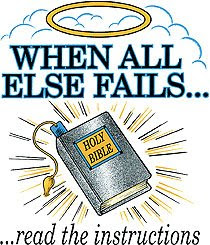 In those two posts, I challenged the way we ask the Bible questions, wondering if it’s the lens though which we should see Jesus/God and our relationship to him instead of a spiritual encyclopedia to serve our questions. I have just a few closing thoughts:
I typed in “Bible answers” into Google, and the very first link, at Bible.com, was typical of the results. Twenty topics are covered on that page, and none have to do with answering the question “Who is Jesus?” or “What does who Jesus is mean?” Instead, they include masturbation, school shootings, finding a spouse, tattoos, beer, gender roles, being gay, and smoking.
My mom once bought me a shirt that had a picture of a Bible on it along with the words, “When all else fails, read the instructions.” I appreciate my mom’s high reverence for the Bible, but to think of it as life’s instruction manual misses the points it’s making, as well as insulting our own ability to think things through if we’re given a framework to work with. It’s silly to suggest that the Bible addresses some of these topics, like school shootings and smoking, since they didn’t exist when the Bible was penned. Still other topics are not addressed directly, while others are of secondary importance at most.
If you investigated that site more, you might say their answers are taken out of context, and there are better, opposite answers elsewhere in the Bible. But why not avoid the controversy by not asking those questions at all? After all, if the Bible is not the center of faith, maybe we should look to who is at the center in order to answer those questions. The Bible does not point to itself for all the answers, but points beyond itself to a man who was God in the flesh.
If we look at Christ’s life, his death and his resurrection, and use the Bible to think about the implications of these events, I argue we would then be better equipped to answer those 20 questions than if we did a Bible word search and just went with what we felt like it said.
And even better than that, revolving our faith around Jesus would allow us to go beyond addressing the issues we care about by actually molding and influencing the questions we even want addressed, fixing my agenda to make it God’s agenda.
Jesus is the center of Christianity, and the Bible is the important, authoritative middle man, telling us about Jesus and fleshing out some implications of Jesus’ life, death and resurrection, so that we can know him accurately and respond accordingly.
Let’s never cut out the middle man. But let’s also never mistake the middle man for the for the ultimate source of faith, hope, love and all things. It’s Jesus Christ.
Sunday, July 20, 2008
What's at the center of Christianity? (2 of 3)
This is part 2 of 3 on Christianity’s center. I suggest reading Part 1 before you read this part. After posting yesterday that we need to depend on what the Bible says about Jesus (and then depend on Jesus for everything) instead of depending on the Bible for everything, I realized that sounds like I don’t take the Bible seriously. I do take all of it quite seriously, and I think we’re lost without it. I think the whole thing from Genesis to Revelation is the Word of God. But I have a beef with what other people sometimes mean when they say the Bible is the “Word of God.”
I never want to jump to conclusions that since the Bible is the Word of God, the Bible is more or less God’s substitute teacher for us. God does have important messages for us in the Bible but to use the Bible to confront other things besides those messages is nonsense. Imagine a religion where people believed Shakespeare was God. Clearly, even if he’s God, his plays are for entertainment. If you started using them for other purposes, you might end up becoming a cannibal, biting your thumb at people, talking to your friends in early modern English or thinking the best result of a conflict is for everyone to just die. It would be downright crazy.
Yet think about the way we approach the Bible with questions. If we take it as our ultimate authority on all matters, then we end up assuming every possible issue is in there if you just look hard enough.
At The Bible Answer Machine you can do just that, asking any question about anything and getting the Biblical answer. Luckily, it barely works, so not too many people are running their life via the Bible Answer Machine. Still, the perspective of that site is very much in line with how most of us use the Bible. On the other hand, if Jesus is the center of Christianity, and the Bible is our “Complete Idiot’s Guide to Jesus,” then what sort of questions should we be asking it? I would argue for these sorts of questions:
Who is Jesus?
What did Jesus do?
What sorts of principles and values does Jesus emphasize?
How should I respond to Jesus?
Of course, only 12% of the Bible, generously, is directly about Jesus’ life. Much of the Bible is about our faith in Jesus or the history of faith. So when reading those parts, we should ask these sorts of questions:
What are the implications of what Jesus did on earth, in terms of who I am and how I live?
What are the implications of Jesus being God in terms of the way the world is and my role in it?
What are the implications of Jesus being the fulfillment of the Old Testament?
What kind of life should I live, and what should I do, in view of who Jesus is?
Since the Bible is about Jesus, all these questions, and others like them, are questions the Bible is designed to answer, questions that the Bible expects you to ask. The more I read the Bible asking these questions, the more blown away and taken in I am by both the Bible’s message and, more importantly, Jesus of Nazareth himself.
Tomorrow I’ll wrap up what’s going through my head on this topic.
(Click here for part 3.)
Saturday, July 19, 2008
What's at the center of Christianity? (1 of 3)
 It's an easy argument that human culture's most influential person has been Jesus of Nazareth.
It's silly, right? He was a typical Jewish Rabbi in a Roman occupied state with a few wise teachings and--allegedly--some unexplainable acts, like healing diseases, restoring sight for the blind, and commanding the weather with his voice.
Let's put aside whether we think he actually performed those miracles. We know what he didn't do: He didn't lead an army. He didn't run for office. Nor did he write a book. On the contrary, he was executed over some theological objections to some of his teachings' implications. On paper, you or I should be more famous.
Nonetheless, this otherwise trivial contributor to human history is quite relevant--to history, to religion, to politics, and to culture, and will continue to be into the next few millennia. Why?
Something convinced those men and women who made up his first followers that he was alive despite his public hanging, and that he was God incarnate (God in human form). They started telling people. As a result, here I stand today, one of a couple billion who thinks this guy is it.
In one sense, that's what Christianity is, to think that Jesus is the one, the man who is not like other humans, the human who shows us the face of God.
Yet we don't seem to pay attention.
I'd like to spend my first three posts exploring a pressing question: Why do we treat the Bible as the center of Christianity when Jesus of Nazareth should be?
You may think I'm asking a stupid question; the Bible is the authoritative book about Jesus, so the more central Jesus is, the more important the Bible, right? I affirm that statement. But I've observed that we often accidentally replace Jesus with the Bible at the center of our faith thoughts instead of explaining him with it.
Often on weekdays I listen to a radio program called “Back to the Bible.” Now, setting aside that this program sometimes has very little to do with getting back to the Bible, why would Christians want to title a radio show like this in the first place? Why not call it, “Back to who Jesus Is” or “Back to what the Bible has to say about Jesus”? Last week on this show they talked for two entire days about one single verse of Job, scrutinizing over the sequence of Job mourning and shaving his head and worshiping. Little to no mention of Jesus. Whaaa??
Once again, I say: What are we putting at the center? “Back to the Bible” is the not a fringe show. In fact, I'd say "Back to the Bible" represents the way most serious Christians think about their faith, if not all the time then some of the time.
I suggest we be more careful to depend on what the Bible says about our all-encompassing almighty master instead of depending on the Bible as the all-encompassing almighty master. The difference can be difficult to see.
In the next post, I'll talk about the kinds of questions the Bible has answers for.
(Click here for part 2.)
Saturday, July 12, 2008
About the Contributor: Joe
Click here to visit Joe's personal website.
Click here to view all posts contributed by Joe. Although I grew up a religious kid, it wasn’t until I attended a yearly Christian weekend retreat in junior high that I was told there was a conflict of interest between my faith and science. Concerned, I asked my dad, a strong Christian example in my life and in the lives of many, what he thought.
“It’s not very important whether Adam and Eve were real people or whether Genesis is a literal history,” he said. I was confused.
Anyway, it didn’t matter much because around that time at one of those retreats my eyes were opened to the more basic details of life: The world is tragically broken beyond man’s repair and I am just as much a part of the hurt as anyone else. But God wouldn’t stand for it and arrived on earth to simultaneously introduce himself to us and bridge the gap between people and him, proving to be a very different God than anyone would imagine. I was told that if I believed in Jesus as the real deal, I could enter a new, eternal world in harmony with God.
Over the next couple years I grew in knowledge and maturity in Christ. Part of that was struggling with belief and the dependability of scripture. I used the internet to research all the arguments, but found them unsatisfying in a genuine search for truth.
Meanwhile, I flailed spiritually, at best, during my first semester of college. But my sisters managed to drag me to a Christian conference where I learned that Christ is truly at the center of everything and is a trustworthy caretaker of my whole life.
Since then, so far that’s been true, and I have learned more and more how to serve Jesus with everything in me. This has included a leadership position in our spiritual movement on campus and a very fulfilling year-long internship with a college missions organization.
But part of that growth in spiritual maturity that has surprised me. As I took really good classes—classes on the Bible and ethics, classes in scientific disciplines, and classes on church history and ancient Near East culture—and talked through all these topics with my friends, I came to believe in the important role learning and our brains should play in our faith.
Many I knew were at the same time rejecting this, trying to rely solely on authority and tradition or trying not to “quench the Spirit” with too much intellectual fluff. For me it was the opposite. The more I opened my mind and made my faith vulnerable to new information, the more excited and sure I got about being a Christian. Academic classes and intellectual freedom were becoming an important driving force in my spirituality.
These days, I live in Columbus, Ohio with my beautiful, intelligent, Christ-like wife. I am involved with Xenos Christian Fellowship and am a freelance writer looking for full-time work. I’m starting to think I should eventually go to seminary to learn more about the Bible.
I pray that this blog causes thoughts to hatch in your brain as well as mine.